
Vol. 4 No. 1 (2026): January
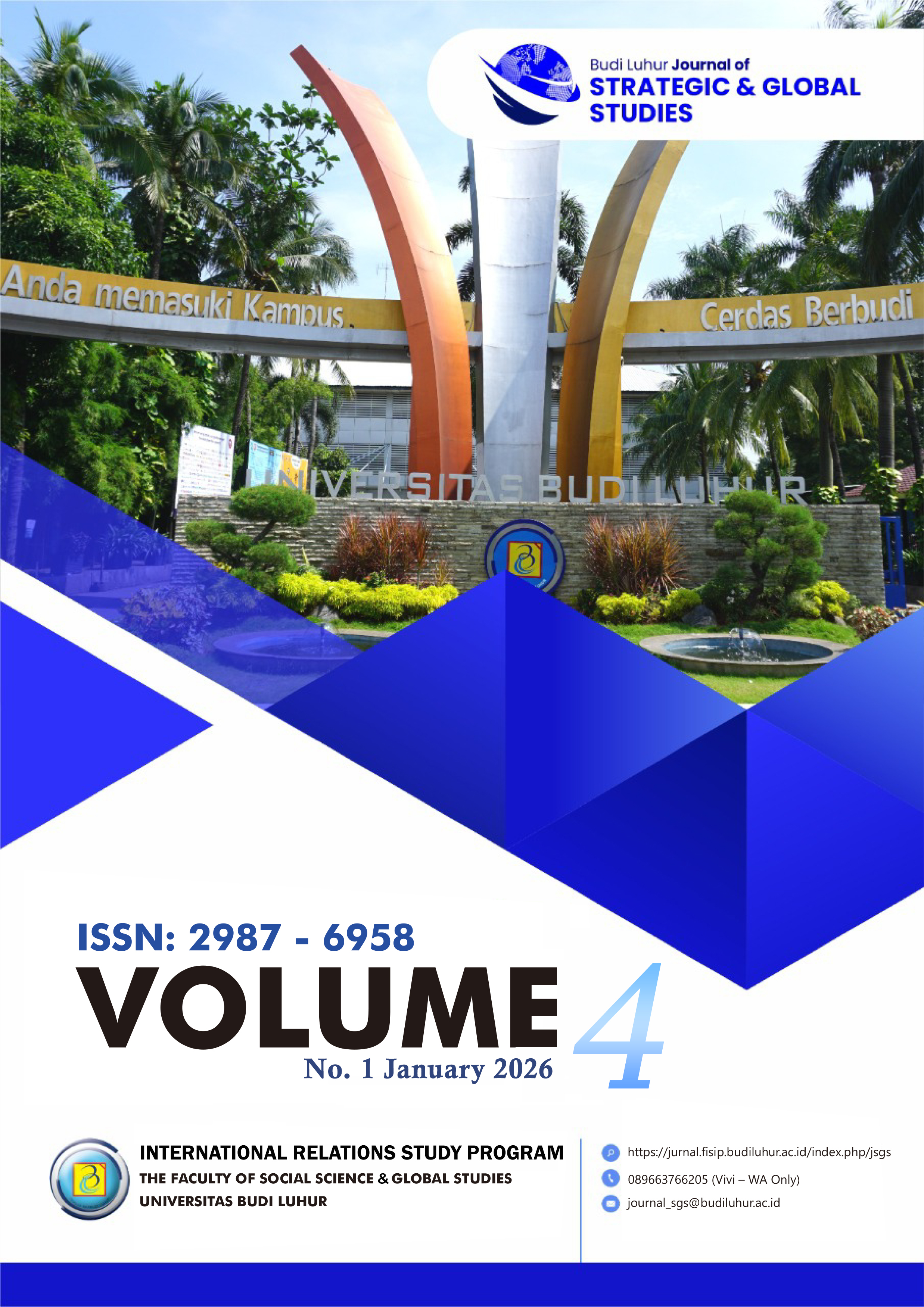
We are pleased to announce that Volume 4, Number 1 (January 2026) of the Budi Luhur Journal of Strategic and Global Studies has been published on schedule. This issue features six scholarly articles authored by contributors from diverse academic and professional backgrounds. Collectively, these works are expected to enrich scholarly discourse and offer valuable insights to our distinguished readers.
The opening article presents a comparative analysis of the Visegrád Group (V4) at a particularly critical juncture in the study of regional integration. Amid prevailing global narratives that tend to emphasize political frictions between Brussels and Central European member states, the author redirects attention toward the more fundamental foundations of economic integration. This contribution invites readers to reassess the structural underpinnings of regional cohesion beyond surface-level political contestation.
The second article, “Post-Pandemic Inflationary Pressure and Global Commodity Price Shocks in Indonesia: An ARDL Estimation,” makes a significant contribution to the field of International Political Economy by examining the transmission mechanisms of global food and energy price shocks to Indonesia’s domestic economic stability. Employing an Autoregressive Distributed Lag (ARDL) model, the study empirically demonstrates that Indonesia’s contemporary inflationary trends are driven predominantly by external cost-push factors rather than domestic demand dynamics. Notably, the contrast between the short-term inflationary impact of oil prices and the long-term deflationary effect of food prices adds important nuance to post-pandemic economic resilience debates.
The third article, “Coastal Women’s Community Resilience Model as a Disaster Mitigation Effort; Inspired by the Motherschool Program from Women Without Borders,” offers a critical perspective within non-traditional security studies by positioning coastal women as central actors in Indonesia’s disaster risk reduction architecture. By adapting the Motherschool learning model from a global to a local context, the authors formulate a structured capacity-building framework at the micro, meso, and macro levels. The findings compellingly demonstrate that family and community resilience to tsunami threats is deeply contingent upon the systematic empowerment of women’s social networks.
The fourth contribution delivers an in-depth International Political Economy analysis, highlighting how domestic regulatory shifts can generate far-reaching disruptions within global supply chains. Focusing on China’s 2019 revision of its Food Safety Law (FSL), the authors examine how this regulatory framework operates as a non-tariff barrier that has directly constrained Indonesia’s porang exports. Beyond its empirical relevance, the article advances a theoretical contribution by illustrating how food safety norms function as instruments of trade control within Indonesia–China bilateral relations.
The fifth article addresses the escalating great power rivalry in the South China Sea, demonstrating how the conflict has evolved from a territorial dispute into an existential geopolitical and geoeconomic contestation. By examining China’s Nine-Dash Line claim and the ongoing militarization of the region, the authors highlight the resulting strategic recalibration by the United States, with potential spillover effects into Indonesia’s sovereign domain. This study offers an important contribution to regional security scholarship by identifying tangible risks to Indonesia’s strategic autonomy amid intensifying hegemonic competition.
The final article in this issue examines Indonesia–United States military cooperation through a detailed analysis of joint military exercises as instruments of defence diplomacy within the increasingly complex Indo-Pacific geopolitical landscape. Drawing upon realist perspectives and national interest considerations, the authors trace the transformation of the Garuda Shield exercise into a multinational platform, reflecting enhanced capacity-building and growing strategic trust between the two countries. The findings are highly relevant to regional security debates, underscoring how strategic autonomy can be preserved through inclusive and carefully calibrated partnerships.
We hope that the articles presented in this issue will stimulate further academic inquiry and constructive debate among scholars, practitioners, and policymakers alike.
Sincerely,
Editor-in-Chief
Budi Luhur Journal of Strategic and Global Studies