Call for Papers – Journal of Strategic & Global Studies (JSGS) Volume 4, Issue No 2, July 2026
2026-04-16

 Budi Luhur Journal of Strategic & Global Studies, published by International Relations Study Program, Faculty of Social Science and Global Studies, Universitas Budi Luhur. Strategic Global Studies publish twice a year (June and December). In each edition, it received article that will be reviewed by internal and external editors. Afterwards, article reviewed by at least two reviewers, who had related expertise. Article will be reviewed with double-blind peer review.
Budi Luhur Journal of Strategic & Global Studies explores critical and constructive inquiries with emphasis on international studies, that include: International Politics, International Economy, Security, Diplomacy, Conflict, Humanitarian, Transnationalism, Development, Peace and War, Globalization, Foreign Policy, and any related issues.
Editorial note
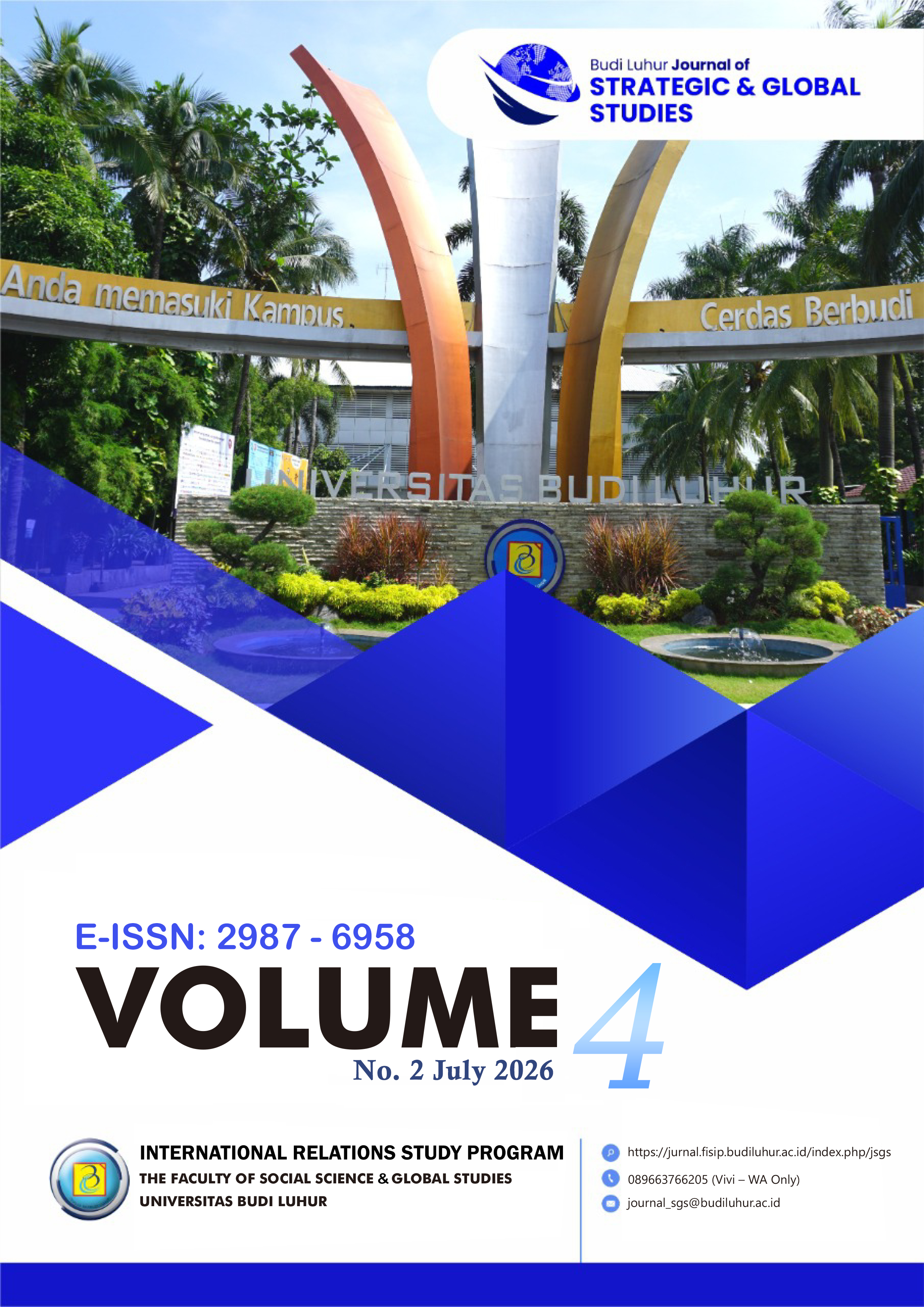
The latest edition of the SGS Journal Volume 4 Number 2, July 2026 presents a collection of critical analyzes that dissect the complexities of the contemporary international relations landscape. Amid the rapid shifts in the world order, the articles in this edition explore how both state and non-state actors respond to power dynamics, multidimensional crises, and the development of new technologies thru various theoretical and empirical approaches. This edition opens with a study of public diplomacy thru the first article that analyzes the Makkah Route Initiative (MRI). Using Joseph Nye's soft power perspective, this study reveals how Saudi Arabia transforms the technological capacity and logistical efficiency of Hajj services for Indonesian pilgrims into instruments of legitimacy and a positive international image. Next, the second article shifts focus to global environmental issues thru an evaluation of China's Green Belt and Road Initiative (Green BRI). By evaluating the implementation of soft law, this article critically demonstrates that flexible environmental standards without strict sanction mechanisms tend to be less effective in promoting sustainable environmental compliance at the international level.
Still within the scope of interstate dynamics, the third article takes us into the realm of regional security thru an analysis of military cooperation between North Korea and Russia. Based on the Constructivism framework, this research demonstrates how a shared historical identity and rejection of Western hegemony have transformed their partnership into a strategic alliance amidst the isolation of international sanctions, while also highlighting the de facto violations of the 2018 Panmunjom Declaration. In the sector of energy geopolitics and economic resilience, the fourth article dissects the crucial impact of the energy crisis—such as the scenario of the closure of the Strait of Hormuz—on Indonesia's national economic stability. This research highlights how the transmission of cost-push inflation pressures the domestic financial system, while also demonstrating that profit-sharing principles and Sharia-based fiscal-monetary instruments have a high adaptability in maintaining macroeconomic stability amid global shocks. The last two articles pay special attention to domestic governance and technological adaptation that impact both local and international levels.
The fifth article evaluates the achievements of Sustainable Development Goals (SDGs) Point 5 in West Java. Thru the lens of intersectional feminism, this research reviews various innovative regional programs such as MOTEKAR and the Jabar Women's School, while also highlighting the disparities in indicator achievements that still require serious attention. Finally, the sixth article responds to the era of Artificial Intelligence (AI) and digital transformation in public administration, using the case study of digitalization policies in Kazakhstan. Integrating the concepts of Trust Management and Knowledge Management, this article offers a "Trust-Based Framework" that emphasizes that the success of AI adoption depends not only on technical infrastructure but also on socio-technical and ethical management.
The six articles in this edition collectively present an in-depth understanding of interrelated issues of security, diplomacy, environment, economy, gender, and technology in the realm of international relations. We hope this edition not only enriches academic discourse but also provides valuable insights for policymakers, researchers, and a wider audience.
Happy reading.
Editor in Chief
Strategic Global Studies is indexed by :



Strategic Global Studies works in collaboration with :
Editorial Address:
TOOLS





Jurnal Strategic & Global Studies
Google Scholar

JOUNAL TEMPLATE

INFORMATION
Published by:
International Relations Study Program, Faculty of Social Science and Global Studies, Universitas Budi Luhur

This work is licensed under a Creative Commons Attribution-ShareAlike 4.0 International License.
View My Stats